Micro habits for beginners are the simplest, most proven way to build lasting change without willpower, motivation, or dramatic life overhauls. If you have ever started strong and quit by week two, this guide was written for you.

Table of Contents
What Are Micro Habits?
A micro habit is a tiny, repeatable action that takes less than two minutes to complete. It feels almost effortless, yet practiced consistently it creates lasting change. Micro habits for beginners work because they remove the main enemy of habit-building: resistance.
Regular habits demand willpower. “Exercise for 60 minutes every day” sounds powerful but collapses under pressure. A micro habit version, “do 10 push-ups right after I wake up,” takes 60 seconds. The key difference is that micro habits for beginners eliminate the friction that stops you before you even start.
Does the idea of changing your life through tiny actions feel too simple? That feeling is completely normal. And it is also exactly why micro habits work so well. They are designed to feel almost silly at first. The consistency is what changes your life, not the size of the action.

Real Examples of Micro Habits for Beginners
- Writing three sentences in a journal every morning (1 minute)
- Drinking a glass of water before breakfast (30 seconds)
- Reading one page of a book before bed (2 minutes)
- Writing down one thing you are grateful for each evening (1 minute)
- Taking 10 deep breaths after waking up (1 minute)
- Sending one encouraging message to a friend daily (2 minutes)
The Science Behind Small Changes
You might wonder whether something so small can really make a difference. The research says yes, clearly and consistently.
The 1% Rule: How Micro Habits Compound Over Time
Behavioral psychologist James Clear shows in his research on atomic habits that improving by just 1% each day leads to being 37 times better by the end of the year. Small, consistent improvements in your micro habits accumulate into results that feel almost unreal when you look back at where you started.

Source: James Clear, Atomic Habits (2018). 1% daily improvement = 37.78x growth in one year.
The 66-Day Rule for Micro Habits
Research published in the European Journal of Social Psychology found that it takes an average of 66 days for a behavior to become automatic. Micro habits, being so small and easy to repeat, survive these 66 days far more reliably than big ambitious goals. That 66-day window is the game. Win it with small actions.
3 Proven Steps to Build Micro Habits
These steps are built on the research of Stanford behavior scientist BJ Fogg and his Tiny Habits method. They work for real people with real lives and real time pressures.
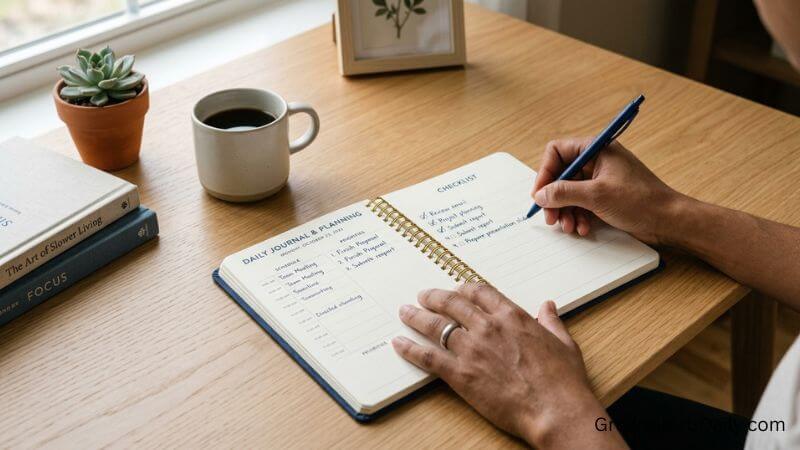
Choose Your Anchor (The Trigger)
An anchor is an existing habit that triggers your new micro habit. It removes the need to remember. Your brain fires the new behavior automatically because it connects to something already wired in.
How to pick your anchor: Choose something you do every single day at the same time and place. Brushing your teeth, pouring coffee, sitting at your desk, or eating lunch all work perfectly.
Real example: “After I pour my morning coffee, I will write down one thing I am grateful for.” That is a complete micro habit with an anchor built in.
Apply the Two-Minute Rule (Keep It Tiny)
Your micro habit must take less than two minutes to complete. This removes every barrier to starting. Once you start, momentum builds naturally and you often do more. But even if you only do the minimum, you are still building the habit.
Goal to micro habit examples:
- Get fit: “Do 10 jumping jacks after breakfast”
- Read more: “Read one page before bed”
- Save money: “Transfer Rs. 100 to savings every morning”
- Build skills: “Watch one 2-minute tutorial after lunch”
- Improve mindset: “Write one positive thought after waking up”
Celebrate Immediately (The Reward)
Right after completing your micro habit, celebrate. Say something out loud. Do a fist pump. Smile genuinely. The celebration does not need to be big. It needs to be immediate. Your brain releases dopamine when you celebrate, and that dopamine wires the habit in permanently.
Celebration examples:
- After journaling: “I am building a better version of myself!”
- After exercise: Give yourself a genuine thumbs up
- After saving: “I am getting closer to my goal every day!”
- After reading: “My mind is growing right now!”

Micro habits succeed more often because they require minimal willpower and are easy to repeat consistently.
Common Mistakes Beginners Make with Micro Habits
Understanding what goes wrong is just as important as knowing the steps. These five mistakes are where most people fail with micro habits for beginners.
Pro Tips for Long-Term Success
| Strategy | What It Does | How to Apply It |
|---|---|---|
| Track Visually | Keeps motivation alive through streaks | Put an X on a calendar every day you complete the habit |
| Stack Habits | Builds a powerful daily routine over time | After habit 1 becomes automatic, attach habit 2 right after it |
| Design Your Environment | Removes friction before it stops you | Put the book on your pillow, the water bottle on your desk |
| Find an Accountability Partner | Increases success rate significantly | Share your micro habit goal with one trusted person weekly |
Want to go deeper on building a consistent daily system? Read this guide on how to build daily habits that stick for a complete practical framework. You can also read about science-backed morning habits that boost productivity to see how micro habits fit into a powerful morning routine. And if you want to understand why consistency matters more than motivation, this article on the power of consistency will completely shift your thinking.
GrowthHubDaily.com exists to give every adult clear, honest, practical growth advice that works in real life. Every article here is built on research, real experience, and a genuine desire to help you grow one small action at a time.
Your 3 Actions for Today
Do These in the Next 24 Hours
- Choose one micro habit that takes under two minutes. Write it down right now. Not tomorrow. Now.
- Identify your anchor. What do you already do every day at the same time? Write the full formula: “After I [anchor], I will [micro habit].”
- Decide your celebration. Pick one specific thing you will say or do immediately after completing your micro habit. Practice it once right now so your brain already knows what is coming.
Frequently Asked Questions About Micro Habits
How long does it take for a micro habit to become automatic?
Research from University College London found it takes an average of 66 days. This varies from 18 to 254 days depending on the person and habit. Micro habits, being so small and easy to repeat, tend to stick faster than larger habits because you rarely skip them.
What if I miss a day with my micro habit?
Get back on track the next day. One missed day is not a broken habit. The research is clear: occasional misses do not destroy habit formation. Two consecutive missed days are where most people permanently fall off. The rule is simple: never miss twice.
Can micro habits help me reach big financial goals?
Yes. Reading 10 pages of a business book daily, spending 15 minutes on a skill, sending one networking message per day. These feel tiny. Compounded over 365 days they produce real, measurable results. Big outcomes are always the sum of small repeated actions.
Should I celebrate even when the micro habit feels too easy?
Every single time without exception. The celebration is not a reward for difficulty. It is a signal to your brain that this behavior is worth repeating. Your brain responds to celebration the same way whether the task took 30 seconds or 30 minutes.
Can I build multiple micro habits at the same time?
Start with one only. After 66 days when it feels completely automatic, add a second. This sequential approach has a far higher success rate than trying to build many habits from day one.
What if my micro habit naturally grows bigger over time?
Let it grow. The two-minute rule is for starting, not for limiting. If your “one page of reading” naturally becomes 20 pages because you got absorbed, that is the habit working exactly as designed. Never force yourself to stop when momentum is there.
Sources
1. Lally, P. et al. (2010). “How are habits formed.” European Journal of Social Psychology. Read the study
2. Fogg, B.J. (2020). Tiny Habits. Houghton Mifflin Harcourt. tinyhabits.com
3. Clear, J. (2018). Atomic Habits. Avery. jamesclear.com