If you have ever tried to build daily habits that stick and failed by day four, you are not alone. Most people do not fail because they are lazy. They fail because nobody told them how the habit brain actually works. This guide changes that.
Table of Contents

Why Most Habits Fail Before Day 10
Here is the honest truth. Most people try to build daily habits that stick the wrong way. They start with too much, too fast.
On Monday they decide to wake up at 5am, exercise for one hour, journal, meditate, and eat clean. By Thursday they are exhausted and feeling like a failure. Does that sound familiar? You are not broken. Your strategy was the problem, not your character.
Your brain treats big sudden changes as a threat and resists them. That is literally its job. The secret to habits that stick is making the habit so small that your brain cannot say no. Then growing it slowly from there. Tiny is the strategy, not the weakness.
The Science: How Long Habits Actually Take
A study published in the European Journal of Social Psychology found that it takes an average of 66 days for a new behavior to become automatic. The popular myth of 21 days is simply wrong. The real range is 18 to 254 days depending on the person and the habit.
Source: Lally et al., European Journal of Social Psychology, 2010
Knowing this one fact already changes the game. You are not broken if your habit did not stick in three weeks. You simply had not given it enough time. The 66-day window is the real target. Plan for it from day one.
Source: Lally et al. (2010), University College London
GrowthHubDaily.com exists to give every adult clear, honest, practical growth advice that works in real life. Every article here is written with research, real experience, and a genuine desire to help you grow one habit at a time.
7 Proven Steps to Build Daily Habits That Stick
These steps work together as a system. Each one removes a different reason why habits usually break. Do not skip any of them.
Start With the Smallest Possible Version
Want to build a daily reading habit? Start with one page. Not ten. Not one chapter. One page. Want to exercise? Start with five minutes. The goal right now is not results. The goal is to prove to your brain that you are the kind of person who shows up. Start laughably small and let the habit grow from there.
Attach Your New Habit to an Existing One
This is called habit stacking. It works because you already have dozens of automatic habits every day. Brushing your teeth. Making tea. Opening your phone. Attach your new habit right after an existing one. Example: “After I make my morning tea, I will write three lines in my journal.” The existing habit becomes the trigger. No alarm needed.
Design Your Environment to Make the Habit Easy
If you want to build a daily reading habit, put your book on your pillow. If you want to drink more water, put a bottle on your desk where you can see it. If you want to journal, leave your notebook open on the table. You do not need more willpower. You need smarter design. Make the right action the easy action.
Track It Visually Every Single Day
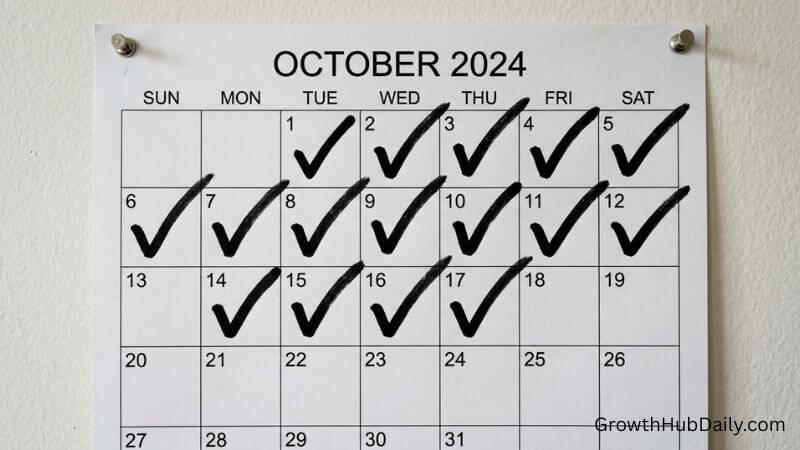
Get a simple calendar. Every day you complete your habit, put a big tick on that date. After one week you will have a chain of ticks. Your brain will not want to break that chain. This is called the “never break the chain” method. It turns consistency into a visual game, and games are far more engaging than willpower alone.
Source: American Society of Training and Development research on habit tracking
Give Yourself an Immediate Reward
The human brain works on a loop: cue, routine, reward. Most new habits fail because the reward comes too late. You exercise for two months before you see physical results. That is too long for your brain to stay motivated on its own. Create an immediate reward. After your habit, enjoy something small. A good cup of tea. Five minutes of your favorite show. A short walk. Make the habit feel good right now.
Use the Two-Day Rule Without Guilt
You will miss a day. That is not a question of if. It is a question of when. The rule is simple: never miss two days in a row. One missed day is human. Two missed days is the beginning of a new habit of quitting. The moment you miss, your only job is to show up the very next day. No guilt. No long reflection. Just return immediately.
Build Your Identity Around the Habit
This is the deepest step. Instead of saying “I am trying to read every day,” say “I am a reader.” Instead of “I am trying to exercise,” say “I am someone who moves their body daily.” Research by James Clear in Atomic Habits shows that identity-based habits are the ones that truly stick long term. When the habit becomes who you are, motivation becomes optional.
3 Biggest Mistakes People Make When Building Daily Habits
Your 3 Actions for Today
Do These in the Next 24 Hours
- Pick ONE habit right now. Write it in this format: “After [existing habit], I will [new habit] for [very small time].” Example: “After making tea, I will read one page.” Write it down before you do anything else.
- Set up your visual tracker today. Stick a blank calendar page on your wall or open a notebook. Draw a line for each day of the month. Your only job is to put a tick every day you complete the habit. Start today.
- Tell one person about your habit. Accountability increases habit success rate by up to 65%. Text someone right now and say: “I am committing to [habit] every day this month.” One message. Right now.
Frequently Asked Questions About Building Daily Habits
How long does it actually take to build a daily habit that sticks?
Research shows it takes an average of 66 days, not 21. Some habits take as few as 18 days and some take up to 8 months. The key is staying consistent through the early weeks when the habit still feels effortful. Once it feels automatic, it will stick without effort.
What is the easiest daily habit to start with for beginners?
Start with a water habit. Drink one glass of water right after waking up every morning. It is simple, immediate, and directly tied to a natural trigger. Once this feels automatic within 3 to 4 weeks, add your next habit on top of it.
I keep failing after a few days. What am I doing wrong?
You are most likely starting too big. The habit feels like effort from day one so your brain resists it. Make the habit smaller than feels reasonable. Keep it that small for at least two weeks before increasing it. Size is almost always the problem.
Can I build daily habits that stick without a habit tracker app?
Yes. A simple pen and a printed calendar work perfectly. Draw a tick every day you complete the habit. The visual chain is what matters, not the tool you use to create it. Apps help but they are not required at all.
What do I do when I miss a day?
Show up the very next day without guilt or drama. One missed day does not break a habit. Two consecutive missed days begins to. The two-day rule is simple: never miss twice in a row. That single rule saves more habits than any motivation tip ever will.
How many habits can I build at the same time?
One. Always start with one. Once it feels completely automatic around day 66, add a second. This sequential approach has a dramatically higher success rate than trying to build multiple habits simultaneously. One habit mastered is worth ten habits abandoned.
Sources
1. Lally, P. et al. (2010). “How are habits formed.” European Journal of Social Psychology. Read the study
2. Clear, J. (2018). Atomic Habits. Avery. jamesclear.com
3. American Society of Training and Development. Accountability research on habit formation and goal success rates.