If you want to know how to build consistency habits, you are in the right place. And I am going to be honest with you from the very first line: I failed at this for years.
Not because I was lazy. Not because I did not care about my goals. But because nobody ever taught me what consistency really means or how to make it actually stick in real life.
This article shares my personal story, real science, and five proven steps that finally helped me understand how to build consistency habits that last. No motivational fluff. No empty promises. Just what genuinely works.

The Childhood Habit That Followed Me Into Adulthood
I was the child who could not study consistently. I would open a book, read for fifteen minutes, get bored, and stop. The next day, same story. Repeat forever.
By exam time, I had a mountain of material and two days to climb it. I would panic, try to cram everything in one go, and fail miserably. My report cards showed E grades. Every single time.
I told myself I was not smart enough. My self-talk became: “I am a failure. I cannot do anything right in my whole life.”
Those words replayed in my head for years. Loudly.
But here is the truth I finally discovered: the problem was never my intelligence. It was my lack of consistency habits. And the most important thing I want you to hear today is this.
Consistency is not a personality trait you are born with. It is a skill you build. Learning how to build consistency habits is something any adult can do at any age, no matter how many times they have failed before.
What Inconsistency Actually Costs You
Most people think the only cost of being inconsistent is not reaching goals. But the real cost goes much deeper than that.
Every time you break a promise to yourself, your brain records it. You slowly lose self-trust. And once self-trust is gone, starting anything new feels pointless before you even begin. That is the invisible damage inconsistency causes.
Here is what the research actually tells us:
- A study published in the European Journal of Social Psychology found that forming a new habit takes an average of 66 days, not the popular myth of 21 days.
- Research by Dr. Gail Matthews at Dominican University shows that people who track their habits are 42% more likely to achieve their goals consistently.
- Small daily actions consistently outperform large, irregular bursts of effort in building any long-term skill or habit.
This is not about willpower or natural discipline. People who know how to build consistency habits simply use smarter systems. Systems that make showing up easy instead of hard.
For a deeper understanding of why systems always beat goals, the research on habit building by James Clear, author of Atomic Habits, is one of the most trusted free resources you can read today.
How to Build Consistency Habits Step by Step
These are not theories I read in a book. These are the exact steps I use in my own life. They are simple, they are practical, and they actually work.
Step 1: Start So Small It Feels Ridiculous
This sounds too simple to matter. It is actually the most powerful step when you are first learning how to build consistency habits.
Do not start with one hour of studying. Start with five minutes. Do not commit to daily exercise. Commit to two squats right after waking up.
Your brain resists big change. It sees a large commitment and looks for every reason to avoid it. But five minutes? Two squats? Zero resistance. And once you start, you almost always do more.
Even if you only do the minimum, you kept a promise to yourself. That small act is how self-trust starts to rebuild. One kept promise at a time.
Step 2: Track Your Habits Every Single Day
Our brains love visible proof of progress. When you see a chain of completed days growing, you feel genuinely motivated to protect it.
This is the “do not break the chain” method made famous by Jerry Seinfeld. He marked an X on a calendar every day he wrote new jokes. The growing chain became its own motivation.
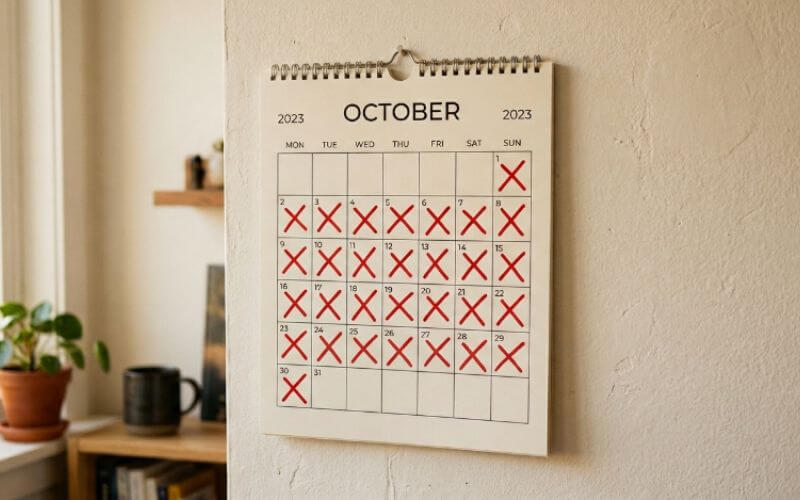
Use a simple notebook, a printed 30-day grid, or a free app like Habitica. Mark each day you complete your habit. Watch the chain grow.
Tracking turns an invisible habit into visible momentum. It is one of the fastest tools for anyone trying to build consistency habits in a real and sustainable way.
Step 3: Remove All Friction the Night Before
Every small obstacle between you and your habit gives your brain a reason to skip it. The goal is to remove those obstacles before they ever appear.
Want to read every morning? Put the book on your pillow tonight. Want to exercise? Lay out your clothes before you sleep. Want to journal? Open the notebook and put the pen on top.
The easier you make your habit to start, the more likely you are to build consistency habits that actually last. Friction is the silent enemy of every good intention.
Step 4: Never Miss Twice
You will miss a day. This is not a warning. This is a guarantee. Life happens.
The old me would miss one day and completely spiral. “I already broke it. What is the point?” One missed day became one missed week. One week became the end of the habit entirely.
Now I follow one simple rule: never miss twice.
Miss Monday? Fine. But Tuesday is non-negotiable. Perfection is not the goal when you are learning how to build consistency habits. Persistence is. Guilt destroys habits. A fresh start builds them.
This is honestly one of the best daily personal growth tips I have ever applied in my own life. Write it down somewhere you can see it every day.
Step 5: Stack Your New Habit Onto an Old One
Habit stacking means you attach your new habit directly onto something you already do automatically every day. No extra willpower required. Your existing routine becomes the trigger.

Use this formula:
After I _____, I will _____.
- After I make my morning tea, I will write for five minutes.
- After I brush my teeth at night, I will read one page of my book.
- After I sit at my desk, I will write my three most important tasks for the day.
This is one of the most powerful and underused ways to build consistency habits without ever needing to rely on motivation alone.
The Science of Consistency: Why Small Beats Big Every Time
Here is what research shows when we compare two approaches to building any skill or habit:
Daily practice wins. Every single time. The brain consolidates memory and builds neural pathways through repetition over time, not through occasional big efforts.

Think of a plant growing through concrete. It does not push hard one day and then take a week off. It pushes a tiny amount every single day until nothing can stop it.
This is exactly why how to build consistency habits matters more than natural talent, motivation, or intelligence. Motivation is a wave. It comes and goes. Consistency is the shore. It stays.
If you also want to understand how your thought patterns affect your results every day, read about the mindset shift from scarcity to abundance that completely changed how I approach my goals and my life.
How Growth Hub Daily Helps You Grow Every Day
Growth Hub Daily is a personal growth blog built for real adults with real struggles. Not the perfectly filtered people you see on social media. Real people who are trying, stumbling, and choosing every day to try again.
Every article here gives you practical steps, honest stories, and tools that work inside your actual daily life. Whether you have five minutes or fifty, there is always something here to help you move forward.
Consistency is not about being perfect every day. It is about showing up even when you do not feel like it. That is where real growth lives.
3 Actions to Take Right Now
Do not close this article and do nothing. That is what the old version of you would do. Here is what the new version does instead:
Do These Three Things Today:
- Pick ONE habit you want to build. Write it down. Shrink it to a version so small it takes less than five minutes to complete.
- Create a 30-day grid in your notebook or on your phone. Mark today as Day 1. Do not skip this step.
- Write your stack sentence right now: “After I _____, I will _____.” Put it somewhere you will see it tomorrow morning.
You do not need to feel ready to start. Confidence and motivation follow action. They do not come before it.
You now know exactly how to build consistency habits step by step. The only real question left is this: will you start today?
Frequently Asked Questions About How to Build Consistency Habits
Did This Article Help You?
Leave a quick review below. Your feedback helps Growth Hub Daily create better content for you.